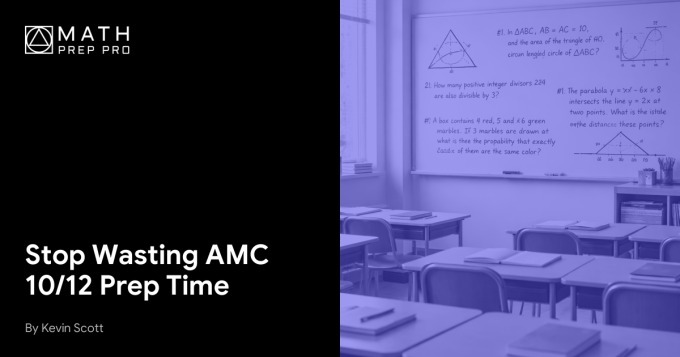
Stop Wasting AMC 10/12 Prep Time
Many students start AMC 10/12 prep early but spend too much time on low-value practice. Learn how to make six months of prep more focused and measurable.
The Problem: More Problems Is Not a Plan
Starting AMC 10 or AMC 12 prep six months early is a real advantage, but only if the practice is useful. Many students open a past contest, solve a few problems, check the answer, feel either encouraged or discouraged, and then move on. That routine creates activity, but not always improvement.
The AMC 10 and AMC 12 are not just content tests. They are 25-question, 75-minute, multiple-choice contests. The clock matters. Accuracy matters. Deciding not to answer a question can matter too, because released AMC instructions have awarded 6 points for a correct answer, 1.5 points for a blank, and 0 points for an incorrect answer.
That format punishes careless guessing and rewards controlled decision-making. If a student spends six months only doing untimed practice, the first real timed test can feel like a different game.
The next listed AMC 10/12 dates are November 5, 2026 for the A contests and November 13, 2026 for the B contests. That gives early starters enough runway to train well without cramming.
The Fix: Turn Every Practice Test Into Data
A practice test should answer more than “What did I score?” It should show what to study next. After a full test or timed set, students should separate problems into categories: confident correct, lucky correct, missed, skipped, and too slow. The most useful category is often “lucky correct,” because it can hide weak understanding behind a right answer.
This is where a structured system helps. Math Prep Pro’s AMC 10 and AMC 12 bundles include timed tests, step-by-step solutions, topic and timing analytics, progress tracking, and AI test reviews. Those tools help students see patterns that are hard to notice from an answer key alone.
For example, two students can earn the same score for different reasons. One may need geometry review. Another may know the content but lose time by staying too long on early questions. A third may miss points through misreading, arithmetic slips, or answer-recording errors. The next week of prep should look different for each student.
Scores are signals. The real work starts when the student asks what the signal means. If you want a clearer review framework, see Analyzing Your AMC Performance: Key Metrics to Track.
The Hidden Leak: Timing and Small Mistakes
Many AMC points disappear through small habits, not missing knowledge. A student computes the radius when the question asks for diameter. Another solves for a side length when the question asks for area. Someone skips question 12, then shifts the bubbles for the rest of the row. These are not deep math failures, but they still cost points.
Timed practice exposes these leaks. It also teaches students not to wrestle with one problem for too long. Since all AMC questions have equal point value, spending ten minutes on one problem can block several reachable questions later. For a deeper pacing approach, Timed Practice for AMC: Why It Matters and How to Do It Right and AMC Math Strategy: How to Improve Accuracy and Speed both expand on this idea.
A better review routine is simple:
- Mark where time was lost, not only where answers were wrong
- Identify whether each miss was content, strategy, or execution
- Rewrite the first step of the correct solution in your own words
- Revisit the same topic within a week, before the lesson fades
This kind of review is slower than flipping to the answer key. It is also where most improvement happens.
Students should also practice under realistic materials rules. The AMC 10/12 allows writing utensils, blank scratch paper, rulers, compasses, and erasers. Calculators, phones, smartwatches, computing devices, protractors, and graph paper are prohibited. If every practice session uses tools that are not allowed, the practice is less honest.
The Better Six-Month Routine
Six months is enough time to build a calm routine. Start with a diagnostic full test. Spend the next few weeks strengthening the topics that appear most often in your misses. AMC 10 students should focus on the contest’s scope, including algebra, basic geometry, area and volume, elementary number theory, and probability. AMC 12 students should expect the broader high school curriculum, including trigonometry, advanced algebra, and advanced geometry, while calculus is excluded.
By the middle months, add regular timed sets. Do not time everything, but time enough that pacing becomes familiar. In the final months, increase full-length simulations and review them carefully. Past AMC 10 and AMC 12 problems are available in long-running archives, so students can practice with contest-style material instead of generic worksheets. If your family is still deciding between levels, AMC 10 vs AMC 12: Which Should You Take in 2025? is a useful comparison.
Families should also handle logistics early. Students and parents do not register directly with the MAA, so they should ask a school or approved local host about participation. Also, students may take either AMC 10 or AMC 12 on a given competition day, not both.
AIME can be a motivating goal, since strong AMC 10 or AMC 12 performance can lead to an invitation. But cutoffs vary by year and contest, so the practical target is better readiness: higher accuracy, stronger pacing, smarter skips, and fewer repeated mistakes.
If you are preparing now, use the extra months wisely. Math Prep Pro can give your AMC 10/12 prep a clear loop: attempt, analyze, review, and return to weak spots until they stop being weak spots.
Resources

Read Similar
Your Complete Guide to AMC 12 in 2026
Everything students and parents need to know about AMC 12 in 2026, including test dates, format, eligibility, topics, registration, scoring, and the new 85-point AIME qualifying score.
AIME 2027 Changes: New Qualifying Scores, Format, and Rules
The 2027 AIME has new qualifying scores, a two-part format, Pearson testing centers, and updated rules. Here’s what AMC 10 and AMC 12 students should know.
Newsletter
Stay Updated & Save More
Get exclusive access to AMC practice test discounts, study tips, and early bird specials. Join thousands of students improving their math skills with our newsletter.

Choose Your AMC Practice Test

These practice tests for AMC are designed to help students develop confidence and improve scores over time.

AMC 8 Practice Tests
Middle School • 25 Q • 40 min
- Over 20 AMC 8 practice tests
- Timed practice tests
- Step-by-step solutions
- AI-powered test reviews

AMC 10 Practice Tests
High School • 25 Q • 75 min
- Over 20 AMC 10 practice tests
- Timed practice tests
- Step-by-step solutions
- AIME preparation
- AI-powered test reviews

AMC 12 Practice Tests
High School • 25 Q • 75 min
- Over 20 AMC 12 practice tests
- Timed practice tests
- Step-by-step solutions
- AIME preparation
- AI-powered test reviews

AIME Practice Tests
High School • 15 Q • 3 hr
- 10 AIME practice tests
- Timed practice tests
- Step-by-step solutions
- AI-powered test reviews